 GET THE APP


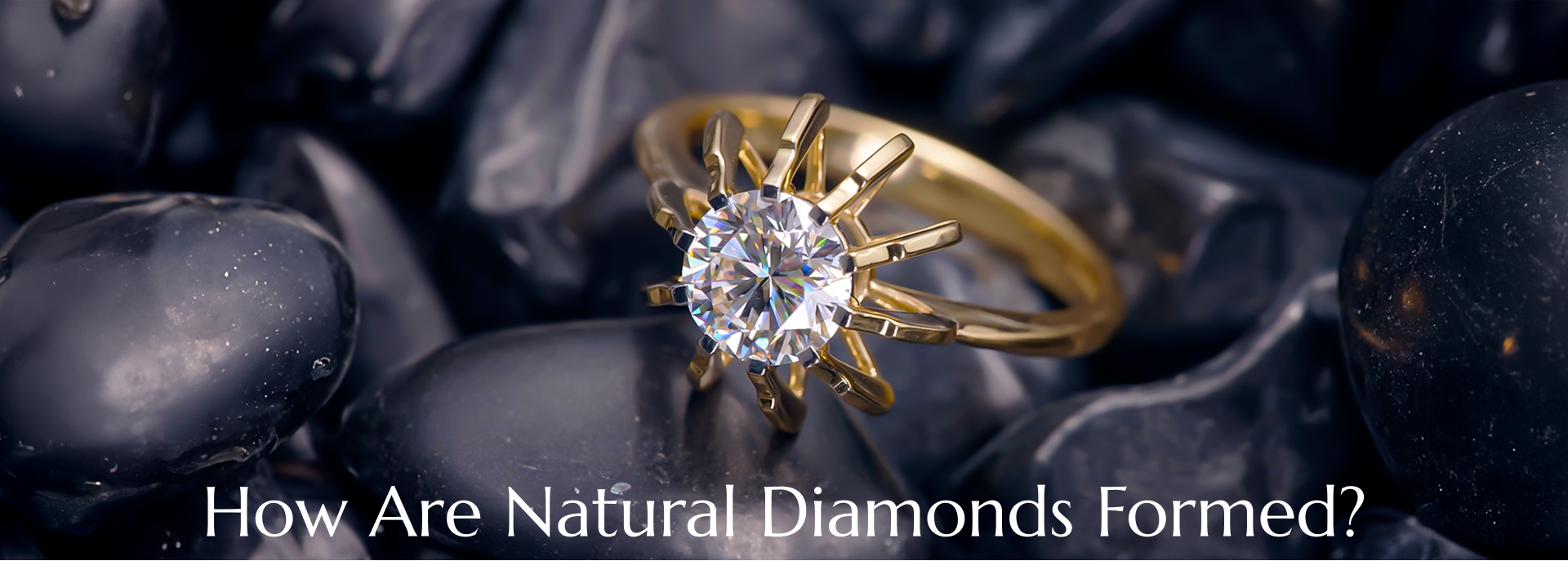
Natural diamonds have captivated human civilisation for millennia, from the courts of ancient royalty to the finest jewellery created today. But beneath their beauty lies a story that is, in the truest sense, as old as the earth itself. Every natural diamond you have ever seen began its existence as carbon, subjected to conditions of almost incomprehensible intensity, deep within the planet, long before human life existed.
Understanding how natural diamonds are formed and what natural diamonds are made of is not merely a matter of scientific curiosity. It is the foundation of understanding why a natural diamond holds the value, the meaning, and the permanence that it does. This is the complete story of how diamonds are formed, told from the beginning.
Let’s explore what is a natural diamond, what is real diamond, and the fascinating processes that bring them to the surface.
What Is a Natural Diamond?
Natural diamonds are a mineral composed entirely of carbon atoms arranged in a crystal lattice structure known as the diamond cubic. This arrangement, unique among carbon structures, gives the diamond its extraordinary hardness (10 on the Mohs scale), its exceptional refractive index, and its optical brilliance.
Carbon exists in various forms, including graphite and diamond, but what sets them apart is their structure rather than composition. In graphite, carbon atoms form flat, loosely bonded layers, leading to a soft material. In contrast, diamonds feature a rigid three-dimensional lattice where each carbon atom is bonded to four others, making it the hardest natural substance. A natural diamond’s uniqueness comes from its formation deep within the Earth, shaped by specific conditions of heat, pressure, and time.
How Are Natural Diamonds Formed?
The question of how diamonds are made has a precise scientific answer, one that unfolds across geological timescales and at depths that remain entirely inaccessible to human beings. There are several processes through which natural diamonds form, each producing a stone that is distinct in its origin, though identical in composition.
Natural diamonds have always been hyped, from ancient royalty where they adorned the finest of jewels to modern pop culture where singers have used them as their muse countless times. But have you ever stopped and wondered how are natural diamonds formed?
The Geological Journey of a Natural Diamond
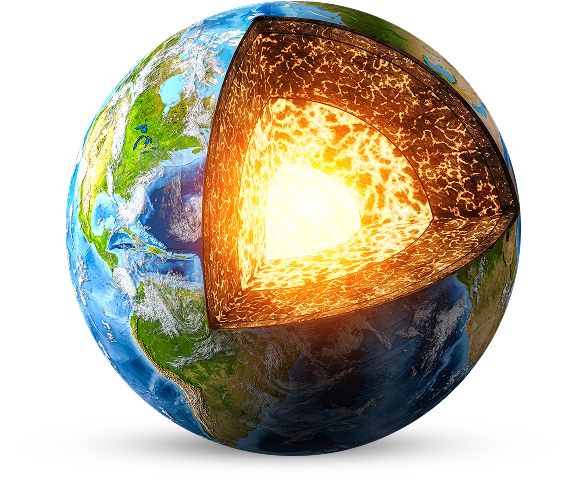
The formation of the vast majority of natural diamonds takes place in the Earth’s mantle, a layer of semi-molten rock that extends from approximately 30 kilometres below the surface down to about 2,900 kilometres. Within the upper mantle, at depths of 140 to 190 kilometres, carbon exists under conditions that are entirely unlike anything at the Earth’s surface.
At these depths, temperatures range between 1,000 and 1,300 degrees Celsius, and pressures reach approximately 45,000 times the atmospheric pressure at sea level. Under these conditions, carbon atoms are compelled into the diamond cubic structure rather than the hexagonal structure of graphite. The process is not instantaneous. It is profoundly gradual, occurring over periods that range from 100 million to 3.3 billion years, making some natural diamonds among the oldest objects a human being can hold in their hands.
Here’s a breakdown of the process:
The Natural Formation Process – Deep Inside the Earth
In the Earth’s mantle, about 140 to 190 kilometres beneath the surface, carbon atoms are subjected to immense pressure (45,000 times the atmospheric pressure) and extreme temperatures (1,000–1,300 degrees Celsius). This allows them to bond in a crystal lattice, forming real natural diamonds.
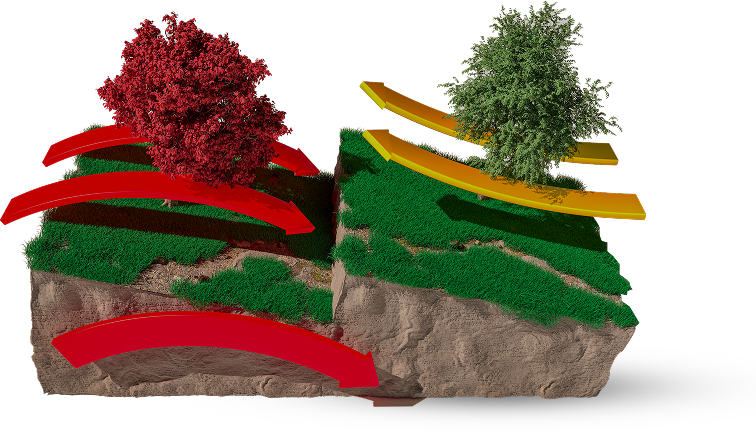
Tectonic Plate
Movement
When tectonic plates shift and collide, they create enormous pressure, pushing carbon deposits deep into the Earth where they crystallise into natural diamonds over time.
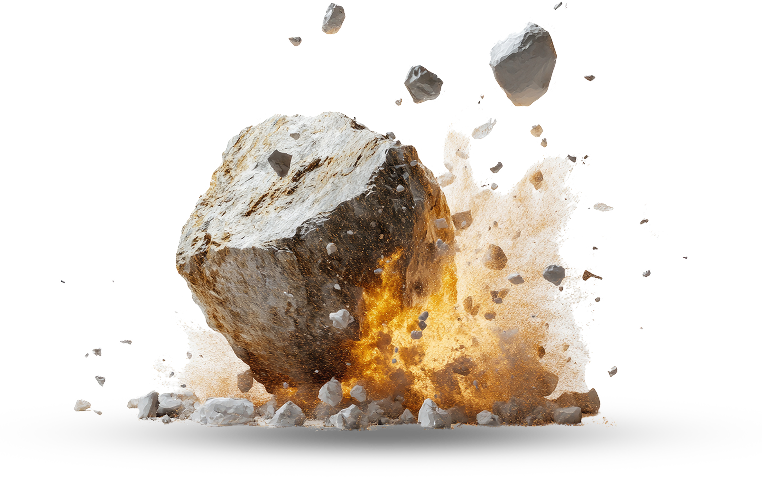
Meteorite Impact
Meteorite crashes create sudden, intense heat and pressure, forming tiny but exceptionally rare real diamonds.
From Mantle to Surface – How Diamonds Make the Journey Up
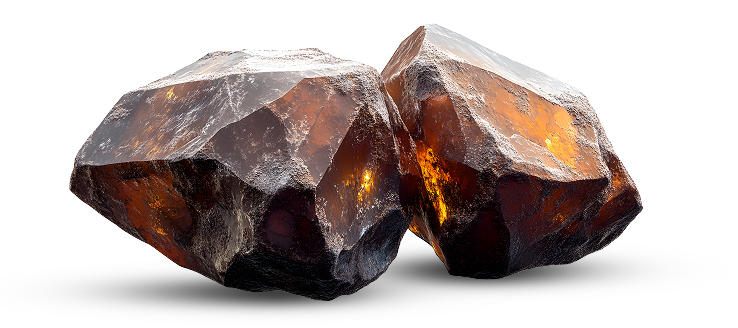
Kimberlite pipes act as natural elevators during volcanic eruptions, transporting natural diamonds from the mantle to the surface. Only specific eruptions carry them safely. Rivers then sweep and deposit these gems through erosion.
What Triggers Diamond Formation? The Role of Tectonic Plates and Deep Earth Chemistry
Diamond formation is not a random event. It is triggered and sustained by specific geological conditions, most of which are concentrated in ancient, stable regions of the earth’s crust known as cratons, the deeply rooted geological foundations of continents that have remained largely undisturbed for billions of years.
Deep Earth Conditions: Heat, Pressure, and Depth
This is the core of how diamonds are made. Carbon reaches diamond-forming zones via subduction of surface material and primordial carbon from the mantle. Tectonic plate collisions create the high-pressure conditions needed for diamond growth. Inclusions within diamonds record the minerals and gases trapped during their formation, preserving their deep origins.
Volcanoes Bring Diamonds to the Surface
Natural diamonds would remain forever inaccessible were it not for a specific type of ancient volcanic event. Deep volcanic eruptions, far more energetic than any recorded in human history, produced what geologists call kimberlite pipes: columns of material that erupted from the mantle through the overlying rock at extraordinary speed, carrying diamonds upward to depths closer to the surface.
Natural diamonds are found today thanks to eruptions that occurred between 70 million and 1.2 billion years ago, which filled volcanic shafts with kimberlite rock. This rock is the primary source of mined diamonds. Over time, erosion disperses diamonds from exposed kimberlite into riverbeds, forming secondary alluvial diamond fields. However, only rapid, high-energy kimberlite eruptions can transport diamonds without allowing them to revert to graphite, ensuring they reach mineable depths intact.
A Diamond’s Unique Formation Makes It Rare
The conditions required to form a natural diamond are extraordinary in both their specificity and their duration. The precise combination of carbon source, depth, temperature, pressure, and time must all align and must remain stable across geological periods during which the surface of the earth has undergone complete transformation. Continents have moved, species have emerged and disappeared, and oceans have changed their boundaries. The diamond, deep in the mantle, formed in silence through all of it.
Only a small fraction of the world’s ancient kimberlite pipes contain diamonds, and of those that do, only a fraction yield stones of gem quality. Roughly one in every thousand rough diamonds recovered from a mine meets the standard required for fine jewellery. The rest are used in industrial applications where hardness, not beauty, is the criterion. This is the true foundation of a natural diamond’s rarity, not scarcity manufactured by any commercial decision, but the irreducible difficulty of the geological process that creates them.
What Does the Formation Process Tell Us About Natural Diamonds?
Time Capsule of the Earth
A natural diamond is, among other things, a geological archive. The inclusions within each stone, the minute crystals, gas bubbles, and structural anomalies that gemmologists assess for clarity grading, are physical records of the conditions that existed in the earth’s mantle at the moment the diamond was growing. Some inclusions contain minerals found nowhere else on the planet’s surface. Others preserve traces of ancient carbon chemistry from periods predating the evolution of complex life.
When a scientist studies the inclusions in a natural diamond, they are studying material that has been sealed from the rest of the world for hundreds of millions of years. No other object that human beings regularly encounter offers this kind of access to deep geological time.
Geological Story in Every Stone
Every unique diamond carries the specific story of the geological environment in which it formed. The crystal’s growth rate, the trace elements incorporated into its lattice, the character of its inclusions, and even its colour are all expressions of that specific origin. A diamond from the Kimberley mines of South Africa formed under different mantle conditions than one from the Argyle mine in Western Australia or the Ekati mine in Canada, and these differences are encoded in the stone itself.
This individuality is not a flaw. It is what makes every natural diamond genuinely one of a kind, not in the marketing sense but in the literal, geological sense. No two natural diamonds, regardless of how similar their graded specifications appear, have shared the same formation environment. Each stone is a singular object, unrepeatable in the history of the universe.
Why Natural Diamonds Are Considered Unique and Precious
The qualities that make a natural diamond precious are inseparable from the conditions that formed it. Its hardness, its optical properties, and its ability to disperse light into its constituent spectrum, all of these are direct consequences of the diamond cubic structure, which in turn is a consequence of the extreme pressure and temperature of the mantle.
Beyond their physical properties, natural diamonds carry a form of authenticity that no human process can replicate. They are objects that predate human civilisation by geological epochs. The earth made them, not as an act of artistic intention but as the inevitable result of physics and chemistry operating over profound time. When a natural diamond is set into a piece of jewellery, that piece carries within it a fragment of the earth’s deep history, held at the surface for the first time in its existence.
It is this combination of physical excellence and geological authenticity that has made natural diamonds the defining material of enduring fine jewellery across cultures and centuries. A heavy diamond pendant set design crafted with natural diamonds does not merely display wealth or craftsmanship. It displays permanence. The same quality of permanence that the diamond itself embodies.
Natural Diamond Jewellery from Tanishq: Expressions of the Earth’s Finest
The story of how natural diamonds are formed finds its most beautiful expression in the jewellery that carries them. At Tanishq, every piece in our natural diamond collection is crafted to honour the extraordinary origin of each stone, setting it within designs that allow its character to be seen and understood fully. The following five pieces represent distinct expressions of natural diamond beauty.
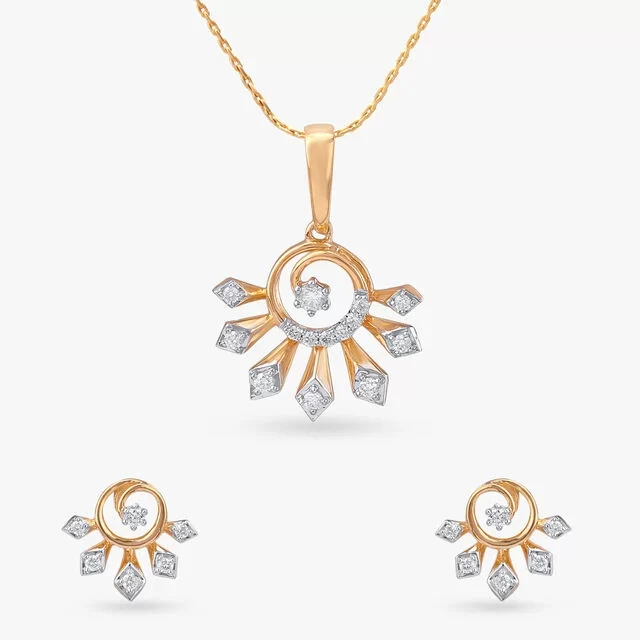
Radiant Bloom Diamond Pendant and Earrings Set
Crafted in 18 Karat yellow gold, the Radiant Bloom set draws its design language from a stylised floral burst. Each petal-shaped spoke is adorned with natural diamonds, creating a piece that speaks simultaneously of organic form and precise craft. The warm gold setting deepens the fire of each stone, making it a natural choice for those who appreciate the connection between nature’s forms and nature’s finest material.
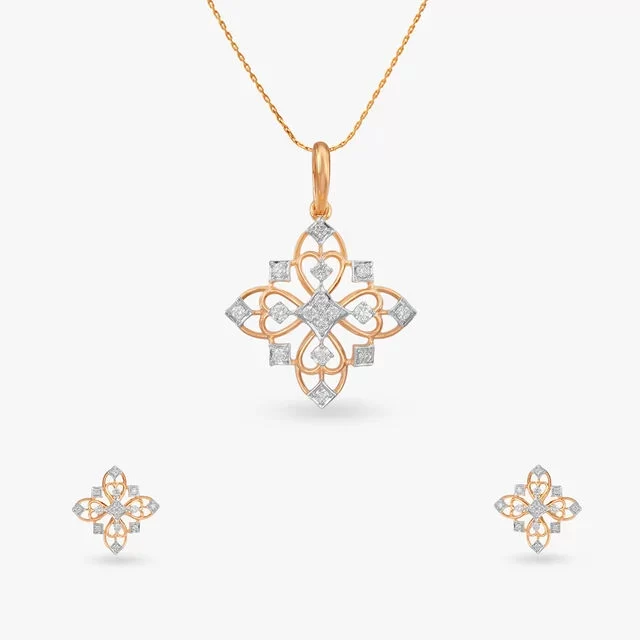
Sparkling Heritage Diamond Pendant and Earrings Set
Set in 18 Karat yellow gold in a filigree lattice, the Sparkling Heritage set is crafted to shimmer with every movement. Its delicate floral motifs are adorned with natural diamonds, making it an ideal companion for wedding and celebration occasions. The filigree framework, an ancient jewellery technique, places this piece in a lineage of craftsmanship as enduring as the diamonds it holds.
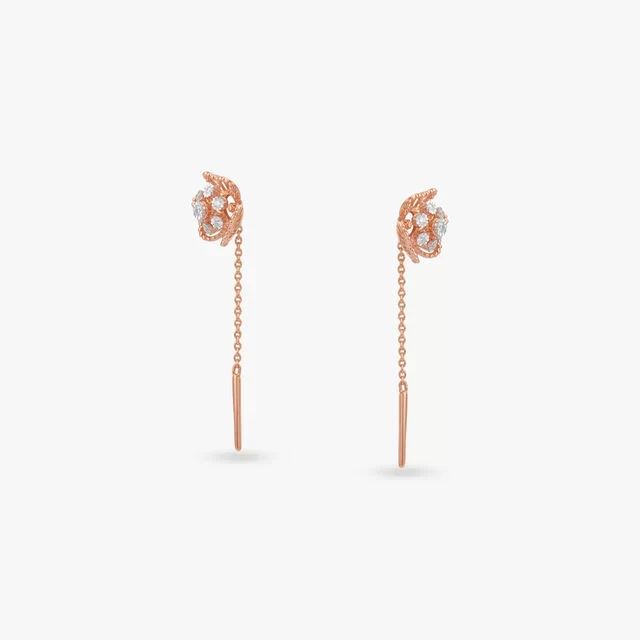
Floral Cascade Diamond Drop Earrings
The Floral Cascade Diamond Drop Earrings are a study in movement and luminosity. Natural diamonds cascade from a floral crown in a design that captures the dynamism of falling light. Crafted to be worn on occasions that deserve to be remembered, these earrings demonstrate how the geological journey of a diamond, billions of years in the making, culminates in a moment of extraordinary beauty.
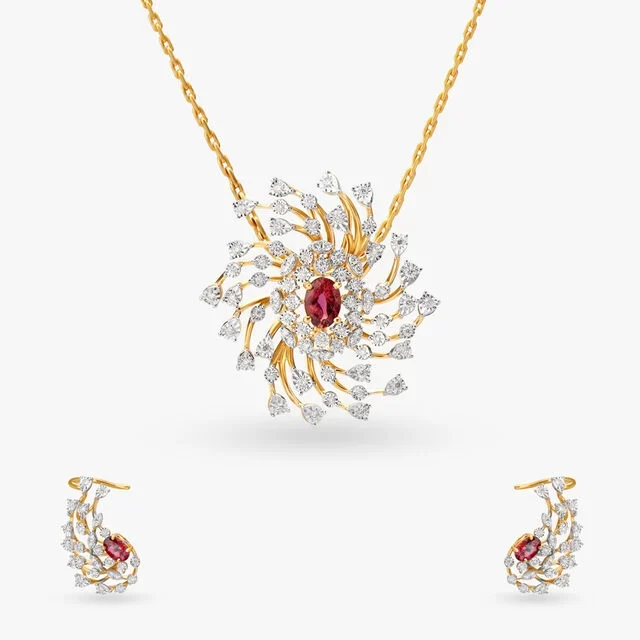
Opulent Diamond Pendant and Earrings Set
Crafted in 18 Karat yellow and white gold, the Opulent set encircles a pink tourmaline with a constellation of natural diamonds. The interplay between the warm gemstone and the cool brilliance of the diamonds creates a composition of remarkable visual depth. Designed for engagement and milestone moments, this set represents the finest expression of natural diamond jewellery at its most celebratory.
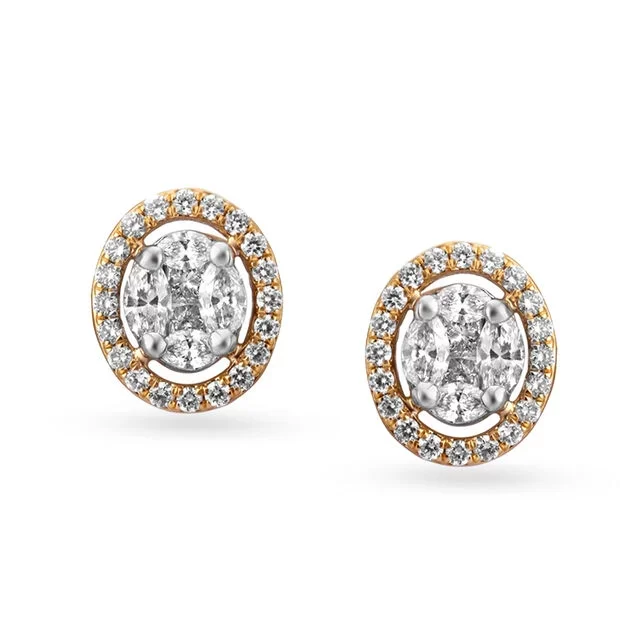
Lovely Solitaire Diamond Stud Earrings in Rose Gold
The solitaire stud is the most direct expression of a diamond’s individual character. Crafted in 18 Karat rose gold, these earrings present each natural diamond without elaboration, allowing the stone’s own brilliance to define the piece entirely. For those who understand that a single, perfectly chosen natural diamond is the most eloquent statement a piece of jewellery can make, this is the definitive choice.
Diamond Expertise Centre (DXC): Exploring the Journey of Natural Diamonds
The story of how natural diamonds are formed does not end in the mantle or the mine. It continues in the way the stone is evaluated, understood, and presented to the person who will own it. This is the purpose of Tanishq’s Diamond Expertise Centre (DXC), a dedicated consultation space designed to give every customer complete transparency and understanding about the natural diamond they are choosing.
For anyone who wishes to understand what is DXC and what it means to choose a diamond, the Diamond Expertise Centre is Tanishq’s commitment to the principle that a natural diamond purchase should be made with complete knowledge. The Diamond Expertise Centre is equipped with gemological instruments that allow customers to see their diamond as a specialist would: under magnification, under calibrated light, and in relation to its grading certificate.
At the Diamond Expertise Centre, you can expect:
- Examination of the diamond’s inclusions under the Clarity Viewer, understanding what those inclusions are, where they originate, and precisely how they affect the stone’s clarity and optical performance.
- Verification of the diamond’s natural origin using the Caratmeter, confirming that the stone is exactly what its certificate describes.
- Assessment of light performance using the Light Scope, revealing how the diamond manages brilliance, fire, and scintillation in precise optical terms.
- Expert guidance on the 4Cs in the context of your specific stone, helping you understand not just the grade but the meaning of that grade for your particular diamond.
The earth took billions of years to create the stone. You deserve more than a moment to understand it.
Myths & Misconceptions about Natural Diamonds
Common myths confuse real diamond origins and value.
- “Diamonds come from coal”
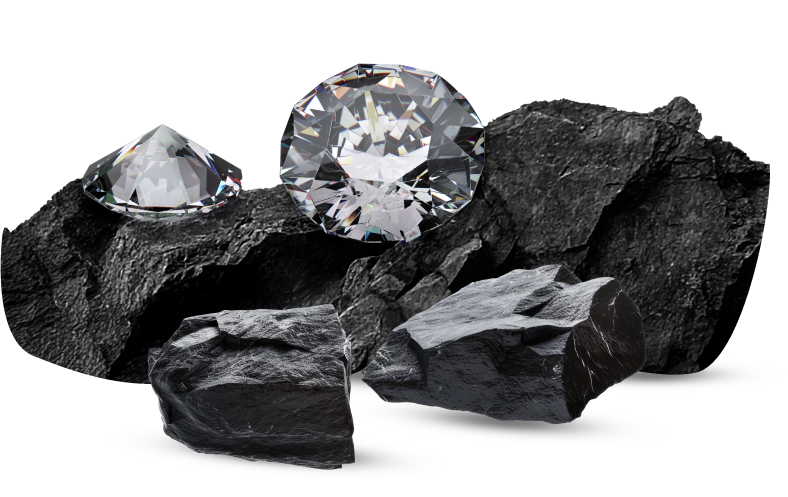
False. Coal forms near surface from plants; natural diamonds predate vegetation, born from pure carbon deep underground.
- “Lab diamonds = real natural diamonds”
Lab stones mimic appearance but lack geological history and rarity. Buy real diamonds for authentic Earth story.
- “Bigger = better”
Quality (4Cs) matters more than size for brilliance and value.
- “All diamonds identical”
Each natural diamond carries unique inclusions from its billion-year journey.
Why This Journey Makes Diamonds Unique & Valuable
The epic voyage creates irreplaceable natural diamonds.
- Billion-year formation: Extreme mantle conditions yield unmatched hardness (10 on the Mohs scale).
- Unique fingerprints: Inclusions reveal individual histories – pressure marks, growth zones, cosmic origins.
- Rarity factor: Only 1 in 1,000 rough diamonds becomes gem-quality real diamond.
- Heirloom status: Natural diamonds appreciate over time, unlike lab alternatives.
Exquisite natural diamond jewellery, like natural diamond ring or natural diamond earring are timeless investment celebrating nature’s artistry.
Conclusion
Natural diamonds are among the most remarkable objects that exist. They are formed not by human hands but by the specific convergence of heat, pressure, depth, and time that only the earth’s interior provides. Every stone that reaches the surface has made a journey measured not in kilometres but in geological epochs, from the deep mantle to a kimberlite pipe, through ancient volcanic events, and eventually to the hands of a craftsperson and then to the person who will wear it.
Understanding how natural diamonds are formed and what natural diamonds are made of transforms the way a diamond is experienced. It is no longer simply a beautiful stone. It is a geological object of extraordinary age and singular origin, a fragment of the earth’s deep interior that has, through one of the most improbable series of natural events imaginable, arrived at the surface.
At Tanishq, every natural diamond we offer is chosen with this understanding in mind. Our collections, from individual solitaire pieces to heavy diamond pendant set designs, are crafted to honour both the stone’s natural origin and the occasion it marks. And at the Diamond Expertise Centre, the full story of your diamond is available to you before you make your choice.
Frequently Asked Questions
Yes. Natural diamonds can be removed from existing jewellery and reset into new designs without losing their quality, brilliance, or durability. This makes them ideal for redesigning heirloom or older pieces while preserving their beauty and history for future generations.
Diamond clarity grades measure the visibility of inclusions and blemishes. The scale ranges from Flawless (FL) to Included (I). Most VS and SI diamonds appear eye-clean, while higher grades are rarer and command premium prices due to their scarcity.
No. A diamond's brilliance does not diminish permanently over time. Sparkle may appear reduced when oils, dust, or cosmetic residues build up on the surface. Regular cleaning and professional maintenance restore its original brilliance and keep the setting secure.
Natural diamonds are rare because they form under specific geological conditions deep within the Earth over millions or billions of years. Only a small percentage of mined diamonds are gem-quality, and an even smaller fraction meets the standards required for fine jewellery.
High-quality natural diamonds have historically retained value and may appreciate over time. Their rarity, limited supply, and enduring demand contribute to their appeal. However, value depends on factors such as cut, colour, clarity, carat weight, and market conditions.
Natural diamond colours result from trace elements and unique geological conditions during formation. Nitrogen can create yellow hues, boron produces blue diamonds, and structural changes can cause pink or red shades, making each coloured diamond exceptionally distinctive.
Yes. Natural diamonds from Tanishq are certified by trusted gemological laboratories such as GIA or IGI. Certification verifies the diamond's cut, colour, clarity, and carat weight, providing independent confirmation of quality and ensuring a transparent purchase process.